Sunday, December 03, 2006


Friday, December 01, 2006
Geology Lessons - 9 - Dacite and those underground Granodiorites
Dacite
Close view of dacite lava from the May 1915 eruption of Lassen Peak, California

Granodiorite

Amphibole Group

Close view of dacite lava from the May 1915 eruption of Lassen Peak, California
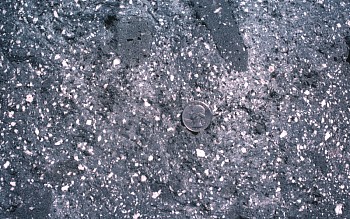
Dacite lava is most often light gray, but can be dark gray to black. Dacite lava consists of about 63 to 68 percent silica (SiO2). Common minerals include plagioclase feldspar, pyroxene, and amphibole. Dacite generally erupts at temperatures between 800 and 1000°C. It is one of the most common rock types associated with enormous Plinian-style eruptions. When relatively gas-poor dacite erupts onto a volcano's surface, it typically forms thick rounded lava flow in the shape of a dome.
Did you know?
Even though it contains less silica than rhyolite, dacite can be even more viscous (resistant to flow) and just as dangerous as rhyolites. These characteristics are a result of the high crystal content of many dacites, within a relatively high-silica melt matrix. Dacite was erupted from Mount St. Helens 1980-86, Mount Pinatubo in 1991, and Mount Unzen 1991-1996.
The word dacite comes from Dacia, a Roman province found between the Danube River and Carpathian Mountains, where the rock was first described.
Granodiorite

Amphibole Group

Friday, November 24, 2006
It All Started with Stephen Jay Gould.


Here's a link to the Stephen Jay Gould Resource Page.
Books by SJG.
(1977)
Ontogeny and Phylogeny
(1977)
Ever Since Darwin
(1980)
The Panda’s Thumb
(1981/1996)
The Mismeasure of Man
(1983)
Hen’s Teeth and Horse’s Toes
(1985)
The Flamingo’s Smile
(1987)
An Urchin in the Storm
(1987)
Time’s Arrow, Time’s Cycle
 (1989)
Wonderful Life
The book that started me thinking about learning about "ishy squishy" things!
(1991)
Bully For Brontosaurus
(1992)
Finders, Keepers
(1993)
Eight Little Piggies
(1993/2001)
The Book of Life
(1995)
Dinosaur in a Haystack
(1996)
Full House
(1997)
Questioning the Millennium
(1999)
Rocks of Ages
(1998)
Leonardo’s Mountain of Clams and the Diet of Worms
(2000)
The Lying Stones of Marrakech
(2003)
The Hedgehog, the Fox, and the Magister’s Pox
(2003)
I Have Landed
Thursday, November 23, 2006
Geology Lessons - 8 - Proterozoic, Vendian/Ediacaran Period
The first extinction of the Precambrian, which largely affected stromatolites and acritarchs, has been correlated with a large glaciation event that occurred about 600 million years ago. This event was of such severity that almost all micro-organisms were completely wiped out.
 Up next on the reading list, Snowball Earth by G. Walker
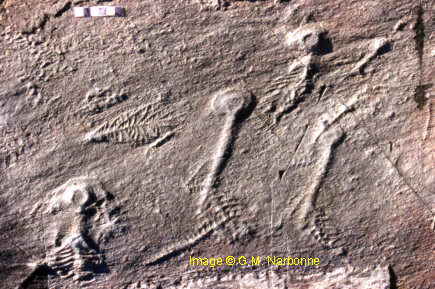
 Known from only a few locales, these represent some of the earliest multicellular life forms. Here's an inventory of these early animals from the UCMP Special Exhibit: Vendian Animals.




 Up next on the reading list, Snowball Earth by G. Walker
650 to 543 Million Years Ago
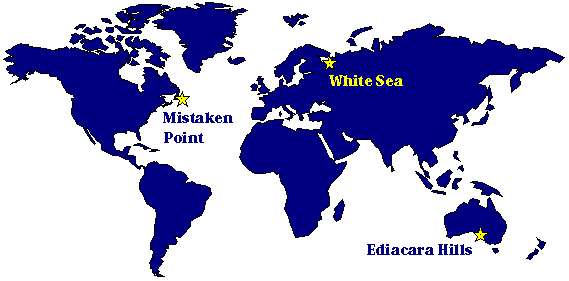 Known from only a few locales, these represent some of the earliest multicellular life forms. Here's an inventory of these early animals from the UCMP Special Exhibit: Vendian Animals.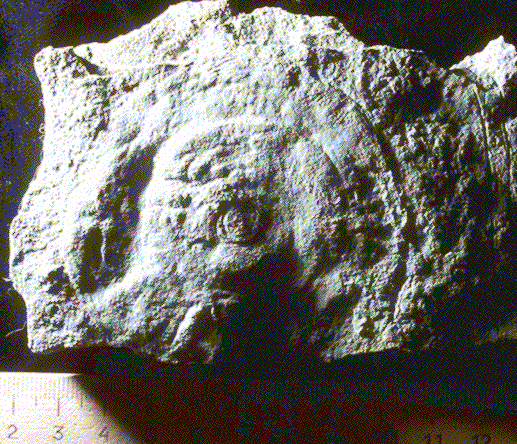
Cyclomedusa is probably the most common and widespread Vendian fossil. It also has one of the largest size ranges, ranging from a few millimeters to about a meter in diameter. Formerly thought to represent a planktonic (floating) jellyfish of some sort, Cyclomedusa is now considered by some to have been a benthic (bottom-dwelling) polyp, somewhat like a sea anemone. It reproduced by division in two or by budding. This specimen is about 5 cm across and comes from the Winter Coast of the White Sea.
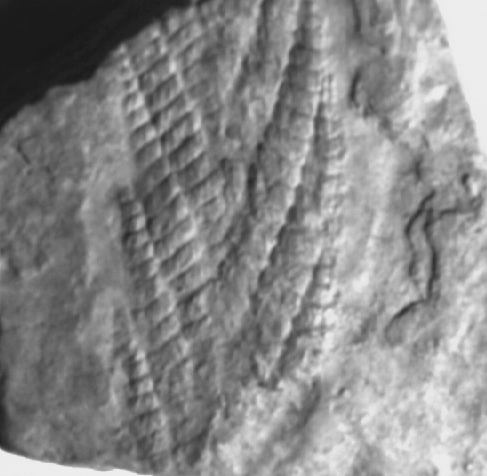
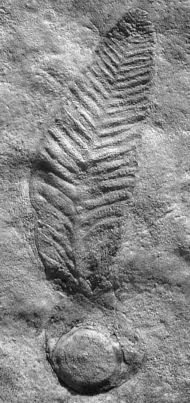
Charnia is one of the largest Vendian fossils, with some specimens reaching one meter in length; unfortunately, complete specimens are rare. The flat, leafy body of Charnia was attached to a disk-shaped holdfast that attached the organism to the bottom (not seen on this fossil).
Charnia was first discovered in rocks exposed at Charnwood Forest in central England. It was thought at first to be an alga, but most researchers tend to place Charnia closest to the living "sea pens" or pennatulaceans, a group of colonial cnidarians distantly related to the corals. Charnia has also been found in north Russia, Newfoundland, and northern Siberia, making it a relatively cosmopolitan Vendian organism.
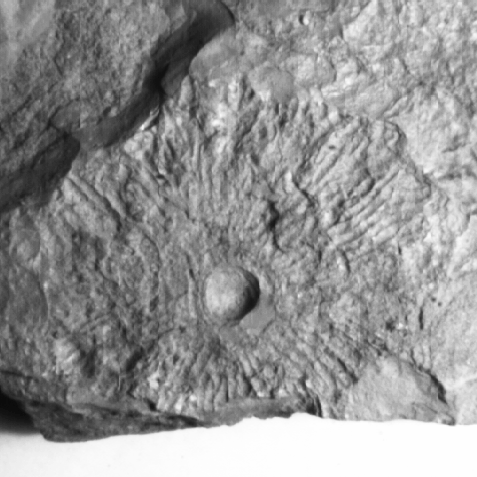
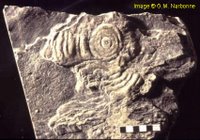
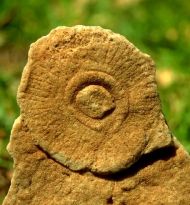
Eoporpita is one of the most striking Vendian fossils, noted for its thick tentacles surrounding a central body. This specimen is nearly six centimeters across and was found at the Winter Coast of the White Sea; other specimens have come from south Australia. Until recently, Eoporpita was thought to be a chondrophorine, but some researchers now doubt this interpretation of Eoporpita and consider it to have been a benthic polyp rather like a sea anemone.
Chondrophorines are cnidarians in the class Hydrozoa; although they look somewhat like individual jellyfish, with a round body from which tentacles hang, they are actually colonies of individual polyps, each one specialized for a function like feeding or reproduction. The whole colony floats with an internal disc-shaped float that may or may not have a sail attached. Living chondrophorines are known as "sailors-by-the-wind" and may wash up on beaches in huge numbers at certain times of the year. They are probably relatives of the Siphonophora, an order of colonial cnidarians that includes the venomous "Portuguese man-o-war".

Nemiana is one of the simplest of all Vendian fossils, and is difficult to interpret. It seems to be an impression of a saclike body. Similar impressions in later rocks and in modern sediments are attributed to sea anemones; unlike most sea anemones, Nemiana has no tentacles, although occasionally central markings are found that could represent a mouth. Other researchers have speculated that Nemiana might be some sort of large protist, or possibly an alga.
We do know that Nemiana was gregarious; it is rare to find isolated specimens. Nemiana could reproduce by splitting in two. On the Winter Coast of the White Sea, there is also a tendency to find abundant Nemiana in rock layers that were formed during or just after some kind of local environmental disturbance. It seems plausible that Nemiana, whatever it was, was a "Vendian weed" — able to colonize disturbed habitats and reproduce rapidly thanks to its very simple anatomy.
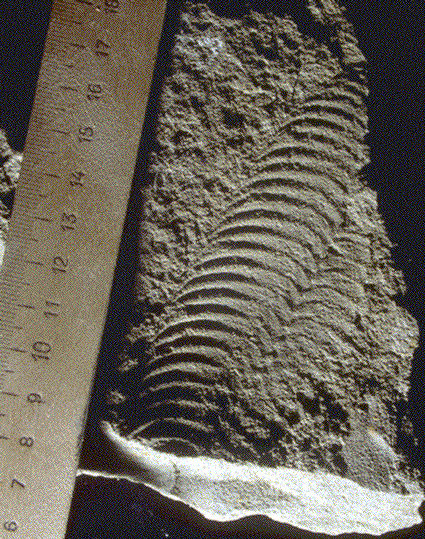
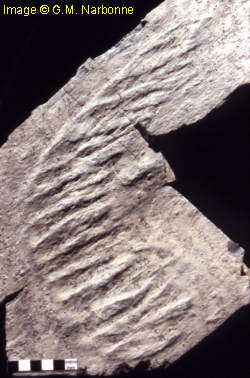
Pteridinium is common at the Summer Coast of the White Sea, and has also been found in Australia, Namibia and North Carolina. Exactly what it was, or how it lived, is open to question. Recent research by UCMP graduate Ben Waggoner suggests that if it was a cnidarian, it was not closely related to living cnidarians; it may belong to a phylum- level group that is now extinct.
Whatever it was, Pteridinium had an elongated, ribbed body that is usually found squashed flat.
By examination of numerous specimens we can tell that it was composed of three ribbed "leaflets" which met along the central midline. It probably lay on the bottom, but we do not know whether it fed on small particles, took up dissolved nutrients from the water, depended on symbiotic microorganisms in its tissues, or perhaps used some combination of these ways of life.

Among the many enigmatic fossils of the Precambrian is an impression named Arkarua adami. The name "Arkarua" comes from a mythical giant snake of the Aboriginal peoples who live where the fossil was discovered — the Flinders Ranges of south Australia, near Adelaide. Arkarua occurs alongside Dickinsonia, Tribrachidium, Cyclomedusa, and other familiar Ediacaran animals as well as many new and as yet undescribed species. The image of Arkarua shown above was taken from the holotype specimen.
Arkarua is a small disc-like fossil, and was described as an echinoderm. If this is correct, then Arkarua is the oldest known echinoderm. The fossils preserve what appears to be a five-lobed central region that is interpreted as five ambulacral grooves, which are characteristic of echinoderms. Unfortunately, the fossils found in sandstone thus far do not preserve any details of the internal organs. No evidence of a stereom or water vascular system is known for Arkarua, and these are considered the diagnostic features for echinoderms, so the identification is still inconclusive.
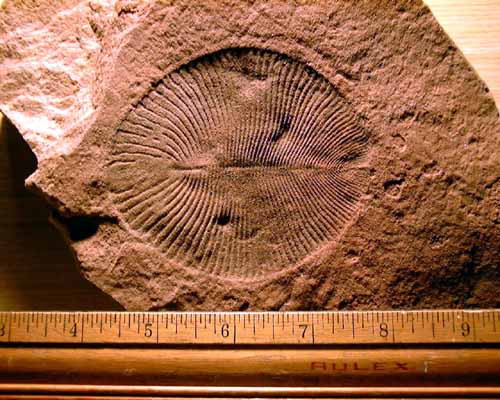
Dickinsonia is known from Vendian rocks of south Australia and north Russia. It is often considered to be an annelid worm because of its apparent similarity to one genus of extant polychaete, Spinther. However, in the opinion of some, it may in fact be a cnidarian polyp, like a soft-bodied version of the "banana coral," Fungia.
The specimen pictured above is an adult one from the Ediacara Hills of southern Australia. We also have a picture of a young Dickinsonia costata from the Winter Coast of the White Sea, in the collections of the Paleontological Institute of the Russian Academy of Sciences in Moscow.
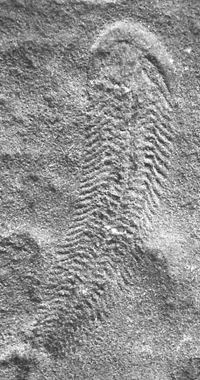
The striking Vendian fossil Spriggina (shown here) and its close relative Marywadea make up the Sprigginida, a clade of soft-bodied organisms that are restricted to the Precambrian. Spriggina is known largely from the Ediacara Hills of south Australia, near Adelaide. The organism had a crescent-shaped head and numerous segments tapering to the posterior end; it is only about three centimeters long.
Spriggina was described as an annelid (segmented worm), but it now appears to be related to the arthropods, although Spriggina had no hard parts, and it is unclear exactly what kind of appendages it had. Compare it to our pictures of trilobites and see what you think!
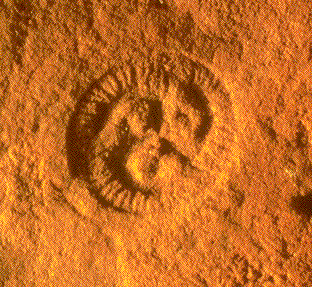
Few fossils of Ediacaran animals are so compellingly bizarre as this unusual disc-shaped form with three-part (triradial) symmetry. Named Tribrachidium heraldicum, its affinities are still mysterious, although distant relationships have been proposed with either the Cnidaria (corals and anemones) or Echinodermata (urchins and seastars).
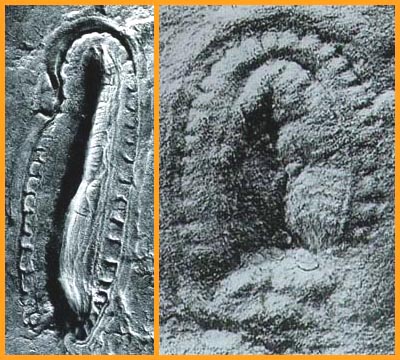
Kimberella, one of the most fascinating Vendian fossils, has received a great deal of attention lately. It was hypothesized to be a box jellyfish (cubozoan) until new information came to light. The original interpretation was based on a small number of specimens from South Australia that looked like four-parted box jellyfishes lying on their sides.
Recently, many well-preserved and large (up to three centimeters across!) specimens from the White Sea region of Russia were found by teams of researchers from the Paleontological Institute of the Russian Academy of Sciences in Moscow (PIN) and UCMP. The new Kimberella specimens were studied Dr. Mikhail A. Fedonkin of PIN and Dr. Ben Waggoner, a former UCMP graduate student.
Fedonkin and Waggoner have shown that Kimberella was a bilaterally symmetric animal that had rigid parts. Specimens of Kimberella from the White Sea are found as relatively deep depressions on the undersides of siltstone slabs. Fedonkin and Waggoner reasoned that Kimberella probably had a tough shell-like covering that rigidly stood up into the sediment when the animals were buried. Thus, Kimberella appears to be somewhat like a mollusc. Nevertheless, it is still uncertain which group of modern animals is most closely related to this interesting animal.
Ediacaran Period Fossil Gallery

.jpg)


.jpg)

The Precambrian: Arizona, California, and Nevada
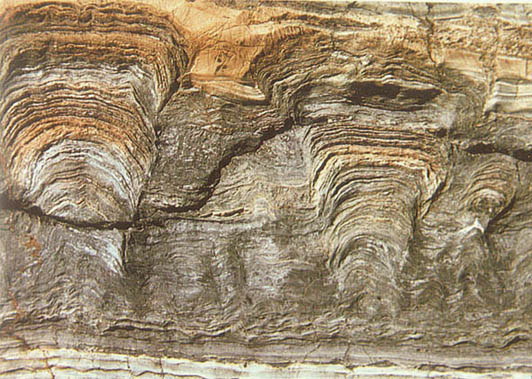
Fossil Stromatolites
Middle Proterozoic - 1700 MA (You can just make out the grey dotted lines of the present state lines. Look for Arizona, California, Nevada.)
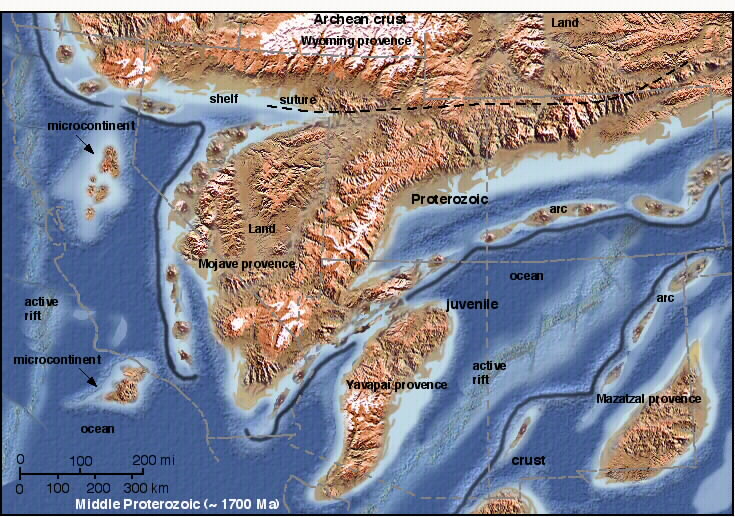
"The interpretation of the earliest geologic history of Southwestern North America is very speculative. At approximately 1.7 Ga (1700 Ma), the region probably resembled modern SE Asia. As various tectonic blocks collided, orogenic (mountain-building) events were generated. This view shows what the region may have looked like during these collisional events."
Mesoproterozoic - 1100 MA

"About 1.1 Ga North America was part of the supercontinent Rodinia. The Southwest possibly lay adjacent to Australia and/or Antarctica or possibly Siberia. An arc complex lay off southern North America. Various sedimentary rocks were formed near the margins of North America."
Neoproterozoic - 650 MA
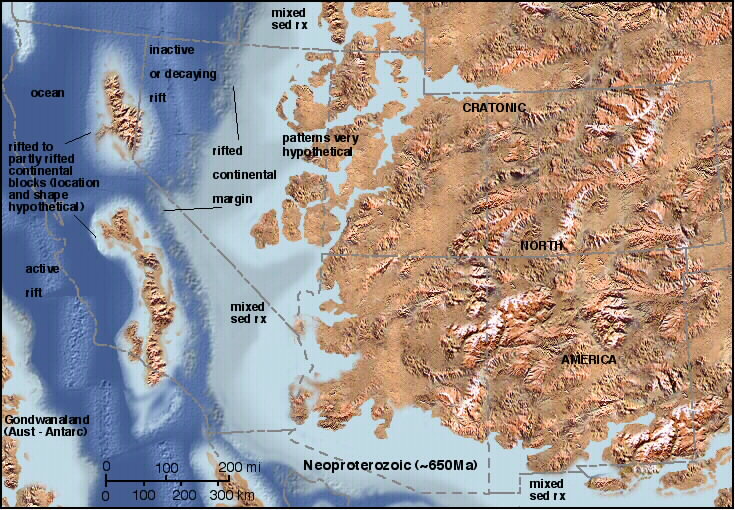
"The western margin of North America (NAM) was originally formed during the late Proterozoic (Precambrian), about 650 million years ago, during a major rifting event in which North America separated from the supercontinent Rodinia. The map shows the hypothetical pattern of rifting and the resulting patterns of late Proterozoic siliciclastic sedimentation. The rifted, attenuated (thinned and stretched) margin subsided and was the site of thick sequences of sandstone, mudstone, and limestone. The Cordilleran passive margin was born."
Arizona - Geologic Periods in Arizona (See the interstates.) There are a lot of resources for Arizona at The Paleontology Portal. See the link under Resources on the sidebar.

Locations of Exposed Precambrian Deposits in Arizona

Precambrian rocks in Arizona record at least three sequences of deposition, metamorphism, and erosion. Sediments were deposited, buried, turned to rock, and altered by heat and pressure. Then some of the rocks were eroded, and new sediments were laid down. By the Late Precambrian, shallow marine conditions prevailed throughout the state. The limestones formed from this time contain fossil evidence of stromatolites.
California
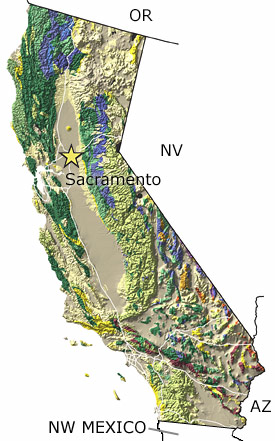
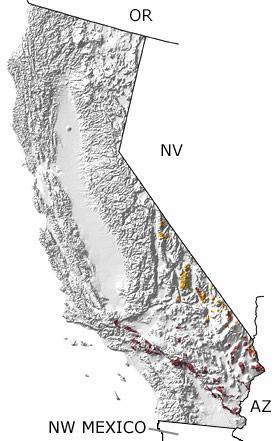
Precambrian rocks in California include igneous and metamorphic basement rocks, as well as some sedimentary rocks (limestone, dolostone, and sandstones, which have often been altered to quartzite). These sedimentary rocks can be found in the White Mountains, Inyo Mountains, and around Death Valley. Most of these rocks do not contain fossils, although some traces and a few fossils have been found in the younger geologic formations of Precambrian age.
Geologic Map of California
Fossils from the Precambrian in California.
Algae

Platysolenites, Shells of Foraminifer
.jpg)
Stromatolites
Worm holes (?)
Fossils In Death Valley National Park
Nevada
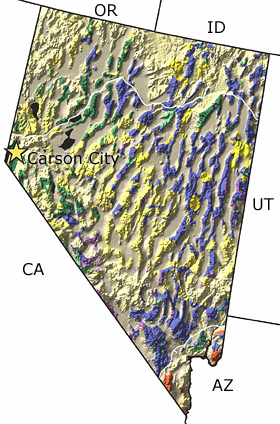
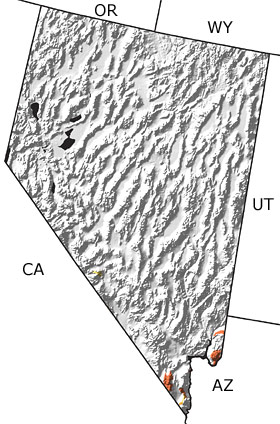
Little is known of the Early Precambrian history of Nevada, as few rocks of this age are preserved. In the Late Precambrian, shallow seas began to flood onto the edge of a quiet continental margin, one where no tectonic activity was occurring. The land was a flat plain with no mountains, and rivers deposited quartz-rich sandstones at the river mouths and nearshore areas. In slightly deeper water, silts and clays were deposited on muddy bottoms. The rocks formed from these sediments can be seen today in the southern and eastern parts of the state. Some very unusual fossils---shelly tubes a few millimeters in length---have been described from Precambrian rocks in Esmeralda County in western Nevada.
See Guide to Fossils in Death Valley National Park above.
Turquoise, Southwest USA
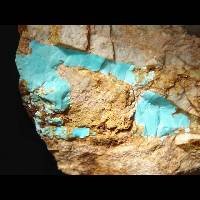 Kingman Area, Arizona
 Mineral Park Mine, Arizona
 Sleeping Beauty Mine, Arizona
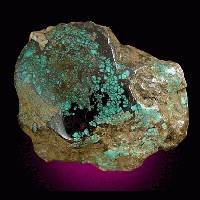 Tombstone District, Arizona
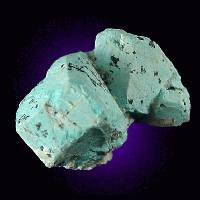 Apache Canyon Mine, San Bernardino County, California
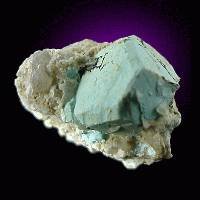 Apache Canyon Mine, San Bernardino County, Arizona
 Baker, San Bernardino County, California
 San Bernardino County, California
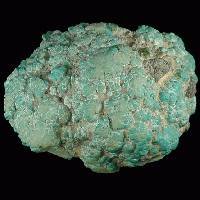 Crescent Peak Mine, Nevada
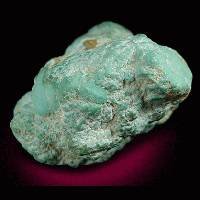 Fox Mine, Nevada
 Silver Coin Mine, Nevada
 White Horse Mine, Nevada
Images from mindat.org.
Subscribe to:
Posts (Atom)